


GEO for Shopify: How to Optimize Your Store for AI Search
By Mitali Purkait Ghosh on August 21, 2026
Search is changing, and so are the rules for getting your Shopify store noticed.
For years, ranking on Google meant optimizing your pages for keywords, backlinks, and technical SEO. While those factors still matter, Visibility Mesh discovered in their recent study that only 13% of Shopify stores are visible in AI search. But they aren’t “bad” stores, just invisible. What has changed?
Instead of showing a list of blue links, platforms like Google AI Overviews, ChatGPT, Gemini, Claude, and Perplexity now summarize information and recommend products directly within their responses. AI search has introduced a new way of thinking about search visibility: Generative Engine Optimization (GEO).
So, what is it? Simply put, it’s the process of making your Shopify store easy for AI search engines to understand, trust, and recommend. Unlike traditional SEO, which focuses on helping search engines rank your pages, GEO for ecommerce is about helping AI systems interpret your products, your brand, and your website accurately enough to feature them in AI-generated answers.
If you’re investing in Shopify website design services in India, building a new online store, or improving an existing one, GEO should now be part of your long-term growth strategy. This guide will walk you through the essential steps to improve your store’s AI visibility, from structured data and product optimization to crawlability and trust signals.
Looking to hire a Shopify developer in India? These strategies will help you prepare your store for the future of search.
How AI Search Understands Your Shopify Store

Before diving into implementation, it’s important to understand how AI search works.
Unlike traditional search engines that primarily match keywords with webpages, AI models build a much deeper understanding of your content. They read your product information, analyze structured data, review customer feedback, interpret website hierarchy, and even compare information from trusted external sources before deciding whether to recommend your business.
So, if your website is well-organized, clearly labelled, and easy to navigate, AI can quickly understand what your business offers. But if product information is incomplete, pages lack structure, or important details are hidden, AI has to guess, and it usually won’t.
That’s why Shopify store AI optimization is about much more than adding keywords. Your store needs to communicate clearly with both people and machines.
AI systems typically gather information from:
- Product pages
- Structured data (Schema markup)
- Google Merchant Center feeds
- Customer reviews
- Website content
- Collection pages
- Brand information
- External mentions and citations
The clearer and more complete these signals are, the easier it becomes for AI to recommend your products with confidence.
That’s also why many businesses are expanding beyond traditional SEO and adopting Generative Engine Optimization strategies alongside their existing digital marketing efforts.
Shopify Online Store Optimization Tips

Implement the Core Schema For Shopify GEO
If there’s one technical improvement that has the biggest impact on AI understanding, it’s structured data.
Schema markup, commonly written in JSON-LD format, acts like a translator between your Shopify store and AI systems. Instead of asking AI to figure out what a page is about, schema explicitly tells it.
For example, rather than guessing whether a page is selling a product, publishing a blog, or answering a question, the different schema types recommended by Schema.org provide a standardized way for search engines and AI systems to understand.
This is one of the best practices for Shopify GEO because structured data removes ambiguity and helps AI understand your content with greater accuracy.
Why Basic Product Schema Won’t Cut It
Many Shopify themes automatically generate a basic Product Schema, which is a good starting point, but it’s rarely enough for modern AI search.
A minimal schema might only include the product name, price, and image. AI-powered search engines, however, look for much richer information when deciding whether a product deserves a recommendation.
Recommended Shopify JSON-LD Schemas
A complete implementation should include multiple JSON-LD schemas working together to describe your store, products, content, and brand.
Product Schema
This is the foundation of every ecommerce store. Product schema tells AI exactly what you’re selling, including:
- Product name
- Description
- Brand
- Price
- Availability
- Images
- SKU
- GTIN (where applicable)
- Product variants
The richer your Product Schema, the easier it becomes for AI systems to compare your products with others and recommend them to potential customers.
Review and Aggregate Rating Schema
Customer reviews aren’t just helpful for shoppers. They’re valuable trust signals for AI as well.
Adding Review and Aggregate Rating Schema allows AI to understand how customers feel about your products, making review scores machine-readable instead of just visible on the page.
Verified reviews also strengthen your store’s credibility, something AI considers when recommending products.
FAQ Schema
Among all structured data types, FAQ Schema has one of the biggest impacts on conversational search. People ask AI detailed questions like:
“Is this product suitable for beginners?”
“Can I use this outdoors?”
“How long does delivery take?”
If your product pages include well-written FAQs with proper schema markup, AI can use those answers directly when responding to users. That’s why FAQ Schema plays such an important role in any guide for AI search optimization.
Organization Schema
AI evaluates products and businesses both. Organization Schema provides information about your company, including:
- Business name
- Logo
- Website
- Contact information
- Social profiles
This helps establish your brand as a recognizable entity across the web, making it easier for AI to connect all your digital assets.
Breadcrumb Schema
Breadcrumbs may seem like a small detail, but they help AI understand how your website is organized.
Instead of viewing each page in isolation, AI can identify relationships between categories, collections, and individual products. This improves content comprehension while also creating a better user experience.
Article Schema
Your Shopify blog can be one of your strongest assets for GEO.
Article schema helps AI recognize educational content, buying guides, tutorials, and industry insights. For example, implementing these strategies alongside our tips to revitalize your Shopify website design maximizes your chances of appearing in conversational recommendations.
For example, since we offer Shopify website development services in India, we understand that the blogs we post, supported by Article Schema, help improve our chances of appearing in both traditional search and AI recommendations. This increases our visibility.
By combining these schema types instead of relying on basic Shopify product markup alone, you’re giving AI a much clearer picture of your business. It’s one of the most effective ways to optimize Shopify for Generative Engine Optimization and lay the foundation for stronger visibility in AI-powered search experiences.
Fix Product Data for Better AI Readability

Even the best schema markup can’t make up for weak product content. AI search engines still rely on the information visible on your product pages to understand what you’re selling and who it’s meant for.
If your product descriptions are vague, overloaded with keywords, or missing key details, AI has less confidence in recommending your products. That’s why one of the most effective tips for better AI readability of websites is to improve the quality of your product information.
Here’s how you can make your product pages easier for both shoppers and AI to understand.
Review Your Best-Selling Products First
You don’t have to update hundreds of products overnight. Start with the products that generate the most traffic or revenue. Improving these pages first can deliver faster results while giving you a clear process to follow for the rest of your catalog.
Use Descriptive Product Titles
Avoid stuffing your titles with multiple keywords. Instead, write titles that clearly describe the product. For example, instead of:
Premium Cotton Shirt | Men’s Shirt | Casual Shirt | Best Cotton Shirt
Try:
Men’s Premium Cotton Oxford Shirt – Navy Blue
A descriptive title gives AI meaningful context while creating a better experience for your customers.
Stop Keyword Stuffing
Traditional SEO often encouraged repeating keywords several times on a page. AI search doesn’t work that way.
We write naturally, explaining the product as if we’re speaking to a customer in your store. AI models are designed to understand context, not just keyword frequency.
Add Complete Specifications
Customers and AI both appreciate detailed information, including important details like:
- Materials
- Dimensions
- Weight
- Compatibility
- Colour options
- Care instructions
- Shipping information
- Warranty
- Return policy
The more complete your product page is, the easier it becomes for AI to compare your products with similar options.
Focus on Benefits, Not Just Features
Listing specifications is important, but explaining why they matter is even better. Instead of saying:
“Made with stainless steel.”
Explain:
“Made with food-grade stainless steel for better durability and long-lasting performance.”
AI can better understand the value your product offers, which improves its ability to recommend it for relevant user queries.
Add Product-Specific FAQs
Every product answers different customer questions. Including FAQs helps both customers and AI understand your products more thoroughly:
- Is this suitable for beginners?
- Does it require assembly?
- What sizes are available?
- How long does delivery take?
When paired with FAQ Schema, these answers become even more valuable for conversational search.
Remember, the goal isn’t just to tank. It’s to become the answer AI chooses to recommend. That’s the heart of optimizing your Shopify store for AI search.
AI Search Starts with Crawl Access
Even the best-optimized Shopify store won’t appear in AI-generated results if AI crawlers can’t access it. Many businesses focus on improving their content but overlook one simple technical issue—their robots.txt.file.
If important AI crawlers are blocked, your content may never be indexed or used by AI-powered search engines. That’s why crawl access is one of the most overlooked yet essential GEO implementation tips.
Allow AI Crawlers in robots.txt
Review your robots.txt.file and make sure these bots are allowed to crawl your store:
- OAI-SearchBot
- PerplexityBot
- ClaudeBot
- Claude-SearchBot
- Bingbot
- Google-Extended
Blocking these crawlers can reduce your visibility across AI search platforms, even if your traditional SEO is performing well.
How to Update robots.txt in Shopify
Shopify makes this relatively straightforward.
Navigate to:
Online Store → Themes → Edit Code → robots.txt.liquid
If you’re using Shopify’s newer customization options, review the robots.txt settings available for your store. Shopify’s Help Center explains how to customize their robots.txt file safely without affecting important search engine crawlers.
Always test any changes carefully before publishing to ensure you’re not accidentally blocking important search engine crawlers.
Allowing AI bots to crawl your content is a foundational step if you want to optimize Shopify Google AI Overviews and other AI-powered search experiences.
Get Your Store Ready with Universal Commerce Protocol (UCP)
AI-powered shopping is evolving quickly, and UCP is one of the newest developments helping AI understand ecommerce stores more effectively.
Think of UCP as a standardized language that allows AI assistants to interact with product catalogs more efficiently. Instead of interpreting every ecommerce website differently, AI can understand your inventory in a consistent format.
For Shopify merchants, implementing UCP helps improve catalog comprehension while preparing your store for future AI shopping experiences.
A typical setup involves:
- Installing the UCP app
- Enabling UCP from the app settings
- Allowing Shopify to generate your UCP automatically
As AI-powered shopping continues to grow, adopting standards like UCP can give your business an early advantage.
Strengthen Your Google Merchant Center (GMC) Data

Your GMC feed is no longer just for Shopping Ads. It has become one of the most important sources of structured product information used across Google’s ecosystem, including AI-powered experiences.
Keep your GMC account updated with:
- Accurate pricing
- Product availability
- High-quality images
- Correct GTINs
- Product identifiers
- Shipping details
Google’s Merchant Center documentation provides detailed guidance on product data specifications, attributes, and feed requirements.
If available for your setup, enabling Native Commerce within GMC can further improve how Google’s AI understands your product catalog. Complete and accurate product data increases your chances of being surfaced in AI-generated shopping recommendations.
Build GEO-Friendly Content Around Your Niche
One of the biggest mistakes businesses make is treating their blog as an afterthought. Publishing random articles every few weeks won’t build authority with AI. Instead, create a content strategy where every article supports a larger topic.
For example, if you sell fitness equipment, don’t stop at product pages. Create helpful resources like:
- Home workout guides
- Equipment comparisons
- Buying guides
- Maintenance tips
- Beginner workout plans
Each article should naturally link back to relevant products, collection pages, and your main pillar content. This structure helps AI understand your expertise within a specific niche, and benefits both traditional SEO and GEO—more on that below.
Build Topic Clusters Instead of Random Blogs
A strong ecommerce GEO strategy isn’t built around isolated articles, but around interconnected content.
Start with one comprehensive pillar page covering a broad topic. Then create supporting articles that answer specific questions related to that topic. Finally, link everything together.
This creates clear relationships between your content, making it easier for AI to understand your website’s expertise. Over time, these topic clusters help establish topical authority, which is one of the strongest signals for both search engines and AI models.
Whether you’re managing your store yourself or investing in professional Shopify website design services in Kolkata, combining technical optimization with high-quality educational content is essential. This approach will help future-proof your ecommerce business as AI search continues to evolve.
Build Trust and Authority Signals That AI Can Verify
As mentioned, AI search engines evaluate your website and business both. Before recommending your products, they look for signals that show your brand is genuine, credible, and trustworthy.
Here are a few ways to build trust and strengthen your brand’s authority:
Earn Brand Mentions Across the Web
When reputable websites, blogs, news publications, or industry directories mention your business, AI gains more confidence that your brand is legitimate. While backlinks are still valuable, brand mentions also help establish your online presence.
Create a Genuine ‘About Us’ Page
Your ‘About Us’ page shouldn’t be an afterthought. Share your company’s story, expertise, mission, and the people behind the business. A transparent business is easier for both customers and AI to trust.
Showcase Verified Customer Reviews
Reviews are one of the strongest trust signals available. Encourage genuine customers to leave reviews on your website, Google Business Profile, and other trusted platforms. Consistent positive feedback tells AI that your products and services are reliable.
Maintain Consistent Business Information
Make sure your business name, address, phone number, website, and email remain consistent everywhere they appear online. This consistency helps AI connect mentions of your business across different sources.
Build High-Quality Backlinks
Focus on earning links from reputable websites in your industry rather than chasing large numbers of low-quality links. A few trusted references are far more valuable than dozens of spammy ones.
Strengthen Your Brand as an Entity
Modern AI systems increasingly recognize businesses as entities rather than just websites. Keeping your Organization Schema updated, maintaining active social profiles, verifying your Google Business Profile, and creating consistent brand information across the web all contribute to stronger entity recognition.
These trust signals complement your technical optimizations and help AI recommend your store with greater confidence. They also align with Google’s guidance on creating helpful, reliable, people-first content, which emphasizes expertise, originality, and user value.
Don’t Ignore the Technical Foundations
Even the best content won’t perform well if your website is difficult to crawl or slow to load.
Consider technical SEO as the foundation of your guide for AI search optimization. It ensures that search engines and AI assistants can access, understand, and deliver your content efficiently. Before you go live, walk through the ultimate Shopify store launch checklist to ensure all performance bases are covered.
Here are a few essentials to check:
- Improve page speed and aim for a Largest Contentful Paint (LCP) under 2.5 seconds (recommended by Google as part of the Core Web Vitals performance metrics).
- Design your store with a mobile-first approach.
- Keep URLs clean, descriptive, and easy to understand.
- Maintain an accurate XML sitemap and submit it to Google Search Console.
- Fix broken links and unnecessary redirects.
- Compress images without sacrificing quality.
- Regularly review Core Web Vitals and resolve performance issues.
These improvements benefit not only AI search but also user experience and traditional SEO.
GEO vs SEO for Shopify Stores
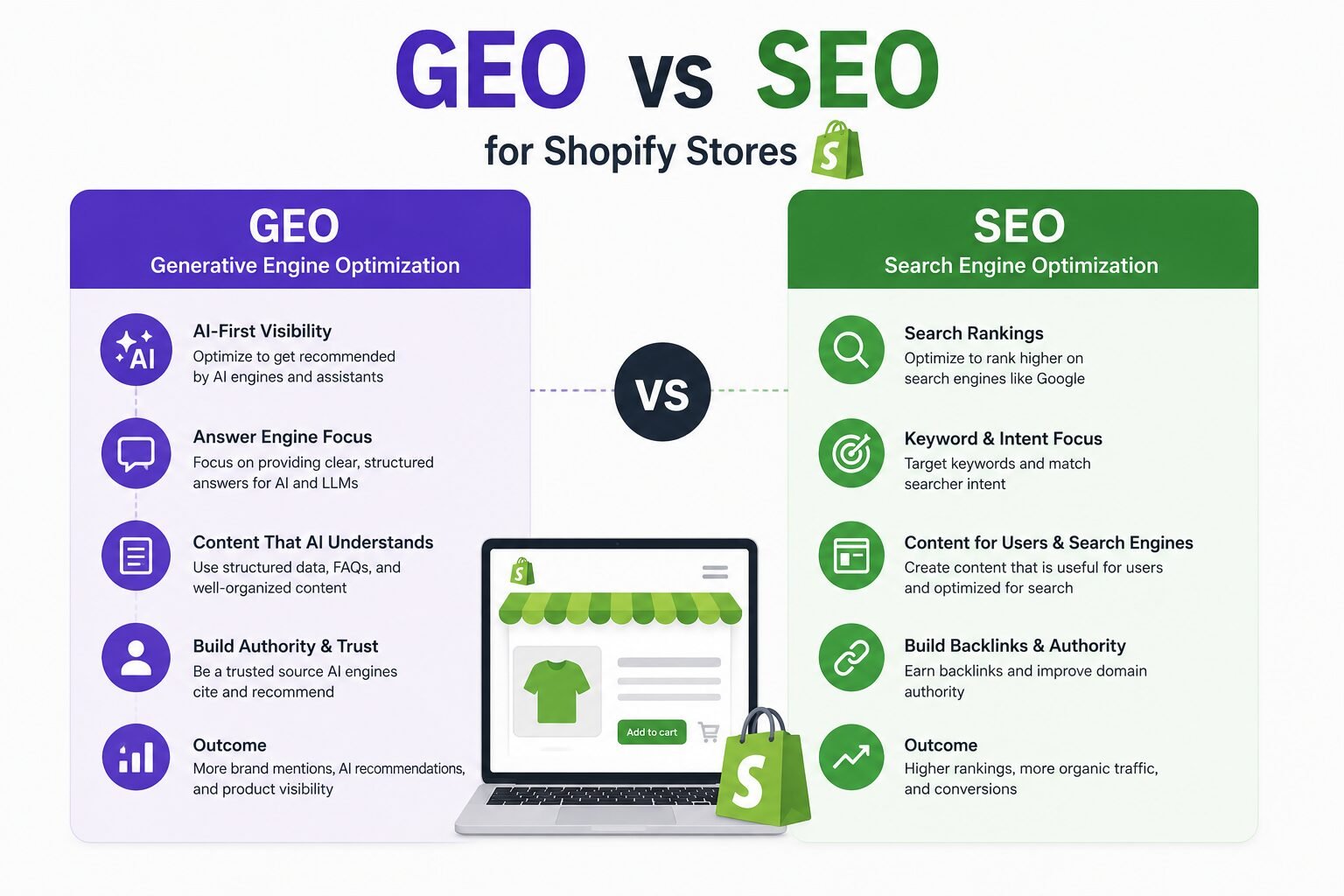
If you’re wondering whether GEO replaces SEO, the answer is no. The two work best together.
Traditional SEO helps your pages rank in search engine results, while GEO helps AI understand, trust, and recommend your products in conversational search experiences.
Here’s a simple way to think about it:
| Traditional SEO | GEO |
| Optimizes for search engine rankings | Optimizes for AI-generated answers |
| Focuses on keywords and backlinks | Focuses on structured data, entities, and context |
| Drives clicks to webpages | Increases the chances of being recommended directly by AI |
| Target search engine algorithms | Targets AI models and generative search platforms |
Businesses that combine both strategies will be in a much stronger position as search continues to evolve.
Future-Proof Your Shopify Store With Us
Optimizing a Shopify store for AI search requires more than adding a few keywords or installing another app. It involves technical expertise, extensive content strategy, structured data implementations, and continuous optimization.
This is where Digital Concepts comes in!
With years of experience delivering web design and development services, we help businesses build Shopify stores that perform well for both people and search engines. So, whether you’re launching a brand-new online store or redesigning an existing one, our team can help you create a fast, user-friendly, and AI-ready ecommerce experience.
From custom Shopify development and technical SEO to structured data implementation and content optimization, we combine modern ecommerce best practices with forward-thinking GEO strategies. If you’re planning to partner with the best web design company in Kolkata, work with a team that understands both SEO and AI search. We know how to give your business the competitive edge it needs.
AI-powered search isn’t a passing trend. It’s changing the way customers discover products online.
As platforms like Google AI Overviews, Gemini, ChatGPT, Claude, and Perplexity become part of everyday shopping journeys, businesses need to think beyond traditional SEO. Success now depends on making your Shopify website design and structure easy for AI to understand, trust, and recommend.
The good news is that preparing your store doesn’t require a complete rebuild. By implementing structured data, improving product content, allowing AI crawlers, strengthening trust signals, and publishing helpful content around your niche, you’ll already be ahead of many competitors.
Start with one improvement at a time, measure the results, and keep refining your strategy. The businesses that embrace GEO strategies today will be better positioned to capture tomorrow’s AI-driven customers.
FAQs
1. What is GEO for Shopify?
GEO (Generative Engine Optimization) for Shopify means optimizing your online store so AI search tools like ChatGPT, Gemini, and Google AI Overviews can easily understand, trust, and recommend your products directly within their conversational answers to shoppers.
2. Does Shopify support GEO?
Yes, Shopify supports GEO, but not through a single built-in setting. Instead, it provides the essential foundation, like customizable code for clean schema markup, product page fields, and control over your `robots.txt` file. This allows you to make your store fully readable and optimized for AI search tools.
3. How is GEO different from SEO?
While SEO focuses on ranking your website at the top of traditional search results (like Google’s blue links) using keywords and links, GEO optimizes your content so AI engines (like ChatGPT and Gemini) understand and recommend your brand directly inside their conversational answers.
4. What is Universal Commerce Protocol (UCP)?
Universal Commerce Protocol (UCP) is a standardized data language that formats your product catalog so AI shopping assistants can seamlessly read and understand your inventory. Instead of interpreting every website differently, UCP provides a consistent structure, helping AI accurately surface and recommend your products to shoppers.

Mitali Purkait Ghosh, the Co-Founder of Digital Concepts, brings a wealth of knowledge and innovation to the marketing sphere. Mitali and her dedicated team offer unparalleled expertise in digital marketing and content writing, among other key online strategies.
Popular Posts
 Top 12 Digital Advertising Platforms to Go for Boosting Brand Awareness in 2024
 - Selling Fragrances Online? Implement These Steps to Make Your Success Smell Irresistible
- 2026 Content Writing Trends: Stay Ahead With These Essential Insights
- How to Use Color Theory in Poster Design?
- The Most Sought-After Typography Trends in Web Design


