


5 Types of Content That Get Cited by AI
By Mitali Purkait Ghosh on November 16, 2026
Getting your content cited by ChatGPT, Google AI Overviews, Gemini, or Perplexity sounds like a big win. And it can be.
But here’s something we want you to think about before you start creating dozens of “AI-optimized” blogs—getting cited by AI and getting leads from AI are not the same thing.
Imagine a potential customer asks ChatGPT, “How can I improve my local SEO?” Your article appears as a source. Great. You have just put your brand in front of that person. But what happens next?
They may click through to your website. They may search for your brand. They may read another article. Or they may simply take the answer and move on. That’s why, at Digital Concepts, we don’t look at content visibility in AI search as the final goal. We look at the entire customer journey.
Content isn’t just content. Often, it’s your customer’s solution to a problem. A how-to guide can solve an immediate problem. A listicle can help someone discover options. An FAQ can answer a concern. An alternative page can help someone explore the market. And a comparison page can help a prospect decide what to buy.
AI search is changing how people discover all of these answers. Google says AI Overviews and AI Mode can surface links from relevant websites, while AI Mode is designed for more nuanced questions, exploration, and comparisons.
So, if you want to know what content gets cited by AI, start by understanding what the person is actually trying to accomplish.
Here are the 5 formats we recommend.
Why Content Format Matters in AI Search Citations

Not every search has the same purpose. Someone searching “how to improve website speed” is looking for information. Someone searching “best website speed optimization agency” is exploring providers. And someone searching “Agency A vs. Agency B” may already be close to making a decision.
The content that answers these searches shouldn’t be identical. Think of the journey like this:
AI visibility → Brand discovery → Website visit → Consideration → Lead or conversion
A citation can help you enter that journey. It doesn’t automatically take someone to the end.
Google also says there are no special AI-only requirements for appearing in AI Overviews or AI Mode. The same SEO foundations still matter: crawlability, indexability, internal links, useful content, good page experience, and accurate structured data.
So, AI search optimization isn’t about writing strange content for machines. It’s about making genuinely useful information easy to discover, understand, and trust.
How to Get Cited in AI Answers: 5 Tested and Tried Content Formats

How-to Guides – Solve a Specific Problem
A how-to guide does exactly what its name suggests. It shows someone how to accomplish something. For example:
- How to improve local SEO
- How to create a social media strategy
- How to add schema markup
- How to optimize content for AI Overviews
This format works well for informational searches because the reader has a clear problem and wants a practical solution. A good how-to article shouldn’t make the reader work to find the answer. Use clear headings, numbered steps, examples, screenshots where useful, and expert commentary.
For example, our guide on How to Use Ecommerce Schema Markup to Boost CTR and Sales explains different types of ecommerce schema and why they matter. Our article on How to Create a Social Media Content Strategy? takes a similar step-by-step approach. We also explore the topic from an AI-search perspective in How Digital Marketing Companies Optimize Your Content Strategy for LLM SEO.
This type of content generally sits earlier in the customer journey. Someone may not be ready to hire you yet. They simply need help, and that’s okay. Solve the problem first. Then, where relevant, show them how your digital marketing services in Kolkata can help.
Listicles – Help Users Discover Ideas and Options Quickly
Listicles are easier to recognize:
- “10 tools for…”
- “7 strategies…”
- “5 ways to…”
But a useful listicle is more than a number followed by a collection of generic points. The format works because people can quickly scan it. AI systems also need to understand clearly structured information when producing answers.
The problem is that AI can generate a generic “10 things you should know” article in seconds. So why would your listicle deserve attention?
Experience. Add your reasoning. Explain why something made the list. Include examples. Mention limitations. Share what you have actually seen work.
For example, our 18 tools to Own Up a Strong Content Marketing Game draws on tools our team has used rather than simply listing popular software. We have also created practical list-based content such as Top 7 Guidelines to Follow When Writing a Social Media Post Copy and 5 Time-Tested Steps for Writing a Good Blog Post and Attract More Audience.
This is the difference between an AI-generated list and a list that demonstrates human expertise.
FAQ Content – Answer the Questions Your Audience Is Already Asking
AI search is conversational. People ask:
- “What does this mean?”
- “Do I need this?”
- “How much does it cost?”
- “Which option is right for my business?”
That makes FAQ content a natural format for conversational searches and long-tail queries. The important part is to answer the question directly. Don’t spend 3 paragraphs introducing the topic before saying what the reader actually wants to know.
Also, don’t create FAQs just because a keyword tool says you need another variation of your target keyword. Build them for real questions.
Look at customer emails. Talk to your sales team. Review Google searches, Reddit discussions, Quora questions, and the prompts customers ask AI tools.
We have used this approach in our article, 5 FAQs for Hiring an Efficient Digital Marketing Agency, where the questions are connected to the actual process of evaluating an agency.
FAQs can work as standalone articles, but they can also strengthen larger guides, service pages, and comparison content.
Alternatives Pages – Reach People Exploring Other Options
An alternative page targets searches such as:
- Alternatives to HubSpot
- Alternatives to hiring an in-house SEO team
- Alternatives to traditional advertising
- Alternatives to a particular software platform
The phrase “alternative to” tells you something important about the searcher. They are already exploring options. This is often closer to commercial investigation than a basic informational search. For an AI content strategy for business, alternative content is particularly useful.
But there’s a catch. Don’t turn the page into a disguised sales pitch. A useful alternative page should explain the strengths and limitations of each option. Discuss pricing considerations, use cases, suitability, and the type of customer each solution may work for.
For example, if you’re comparing an in-house marketing team with an outsourced digital marketing services model, explain where each approach makes sense. This makes the content more useful. It also allows your business to demonstrate expertise without forcing the reader towards a predetermined answer.
Comparison Pages – Help Users Make a Decision
Comparison content deserves a little more attention because it sits closer to the decision stage. Think about a search like “X vs Y.” The person is no longer simply asking what something is. They are evaluating choices. That could be:
- Product vs product
- Service vs service
- Strategy vs strategy
- In-house vs outsourced
- Platform vs platform
A useful comparison should cover:
- Features and compatibilities
- Cost considerations
- Pros and limitations
- Use cases
- Who each option suits
- Genuine differences
- Evidence or data where available
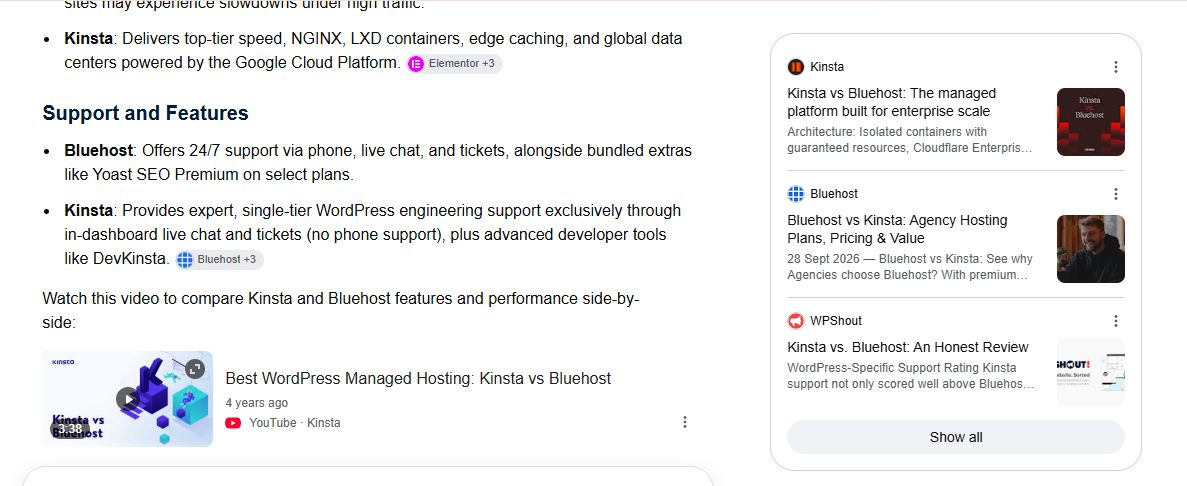
We’ve used this format ourselves. Our article Kinsta vs Bluehost: Which WordPress Hosting is Better? compares performance, pricing, ease of use, and support. We also looked at the decision from another angle in Custom WordPress vs Pre-built Template: Which is Best For Your Business Growth.
Notice something important in these examples: the purpose isn’t to make one option win in every category. A useful comparison tells the reader which options make sense under which circumstances.
That’s exactly the kind of information someone needs when they are close to taking action.
AI Citation vs AI Conversion: What’s the Difference?

Being visible doesn’t necessarily mean being chosen. Here’s the distinction we want every business owner to remember:
| Content Type | Typical Intent | Main Role | Customer-Journey Stage |
| How-to guide | Informational | Solve a problem | Awareness |
| Listicle | Informational/commercial | Discover options | Awareness/consideration |
| FAQ | Informational | Answer questions | Awareness/consideration |
| Alternatives | Commercial investigation | Explore options | Consideration |
| Comparison | Commercial/decision | Evaluate choices | Consideration/decision |
An AI answer may cite your how-to guide because it contains a useful explanation. That can build awareness. But a comparison page may help a prospect decide between two solutions.
Neither is “better” in every situation. They simply perform different jobs.
Why Getting Cited by AI Doesn’t Automatically Generate Leads
An AI Answer May Satisfy the Query Without a Click
This is a zero-click problem. A person can receive a useful answer without visiting your website.
Pew Research’s analysis of browsing activity found that users clicked a traditional search result in 8% of visits when an AI summary appeared, compared with 15% when there was no AI summary. Only 1% of visits involved clicking a link within the AI summary itself.
So, a citation is valuable visibility. But don’t assume every citation becomes traffic.
Not Every AI Query Has Buying Intent
“How do I improve my website?” and “SEO agency vs in-house SEO team: which is better?” are very different questions.
The first may introduce your expertise. The second may introduce your business at a much more commercially relevant moment.
You need to account for both in your strategy.
Brand Mentions, Website Traffic and Leads Are Different Metrics
Think about the journey:
Citation ≠ Click ≠ Lead ≠ Customer
Each one tells you something different:
- A citation tells you that your content was surfaced
- A click tells you someone wanted more information
- A lead tells you someone took a meaningful business action
- A customer tells you the content contributed to revenue
The Right Citation Matters More Than Citation Volume Alone
Getting cited for “what is SEO?” may generate visibility. Getting cited when someone asks, “What should a small business look for when hiring the best SEO company in India?” may put your brand into a much more commercially relevant conversation.
That’s why AI search citations should be evaluated by context, not just volume.
So, Are Comparison Pages Better Than How-to Guides, Listicles, and FAQs?
Not necessarily. It would be risky to build your entire content strategy around one format just because comparison queries can indicate stronger buying intent.
Each format has a role:
- How-to guides build expertise by solving problems
- Listicles create discovery opportunities
- FAQs answer specific questions
- Alternative pages capture evaluation intent
- Comparison pages help people evaluate choices
Your content strategy for generative search should therefore cover multiple stages rather than chasing one “perfect” format.
How the 5 Content Types Work Together Across the Customer Journey
Think of your content like a path.
DISCOVER
How-to Guides + Listicles
↓
UNDERSTAND
FAQs
↓
EXPLORE
Alternatives Pages
↓
COMPARE
Comparison Pages
↓
ACT
Service/Product/Landing Page
For example, a potential Digital Concepts customer could move through:
“How to Improve Local SEO”
↓
“Common Local SEO Questions”
↓
“Alternatives to Hiring an In-House SEO Specialist”
↓
“In-House SEO vs SEO Agency”
↓
SEO Service Page / Consultation
Now you have a content system rather than 5 disconnected blogs.
How to Create Content That AI Can Cite AND Customers Want to Click

Match the Content Format to Search Intent
Don’t start by saying, “We need a listicle.” Start with: what is the searcher trying to accomplish? Then choose the format that best solves that need.
Answer the Core Question Clearly
Don’t bury the answer under 500 words of SEO-friendly introduction. Give the reader what they came for. Then expand.
Bring First-Hand Experience Into the Content
This is where E-E-A-T becomes practical. Add:
- Client experiences
- Campaign lessons
- Real examples
- Screenshots
- Case studies
- Original observations
- Expert commentary
Google’s guidance specifically encourages content that demonstrates first-hand expertise. Creators should focus on people-first content rather than only optimizing content for generative engines.
Add Expert Insights That Generic AI Content Cannot Replicate
AI can summarize what already exists. Content writing services can explain what happened when you actually implemented something. This difference is critical.
At Digital Concepts, our content writers, SEO specialists, and digital marketers bring campaign experience into the content. We don’t simply publish anonymous, generic articles.
Support Claims With Reliable Sources and Original Data
If you make a factual claim, support it. Use primary sources, research studies, official documentation, and credible industry data.
Google’s own guidance recommends original information, research, analysis, and substantial additional value rather than simply rewriting what other websites have already published.
Make Comparison Content Genuinely Useful
Don’t manipulate a comparison so your business conveniently wins every category. If another option is better for a particular customer, say so.
That’s more useful to the reader and makes your expertise more credible.
Connect Informational Content With Commercial Content
Your internal links should guide the reader naturally:
Blogs → Comparisons → Case Studies → Service Pages → Consultation
This is how content visibility can become business visibility.
How to Find Content Ideas For Each of These 5 Formats
You don’t have to guess. Look at:
- Google Search and People Also Ask
- Google Search Console
- Competitor SERPs
- ChatGPT
- Google AI Overviews
- Gemini
- Perplexity
- Quora
- Customer emails
- Sales-team questions
- Client meetings
- Internal search data
The trick is to turn one subject into multiple pieces of content. For example, instead of writing one generic SEO article, build a cluster around local SEO:
- How-to: How to Improve Local SEO
- Listicle: 10 Local SEO Strategies for 2027
- FAQ: 10 Questions Businesses Ask About Local SEO
- Alternatives: 5 Alternatives to Managing Local SEO In-House
- Comparison: In-House Local SEO vs SEO Agency
Now you have 5 pieces serving different search intents. That’s a GEO content strategy for businesses built around the customer journey rather than 5 random keywords.
How to Measure Whether Your AI-Focused Content is Actually Working
AI Visibility and Citations
Track where your brand content appears in AI answers and how frequently.
Remember that AI responses can vary by query, location, context, and platform. Treat citation tracking as a directional visibility metric rather than a fixed ranking position.
AI Referral Traffic
Look for traffic coming from AI platforms.
OpenAI, for example, says ChatGPT search can provide links to relevant sources, and its publisher guidance provides mechanisms for tracking inbound traffic from ChatGPT search.
Organic Search Performance
Keep an eye on key search metrics, including rankings, impressions, clicks, and queries, to ensure high visibility.
AI search does not make traditional SEO reporting irrelevant.
Engagement
Analyze visitor behavior on-page to see if your content genuinely answers their intent and keeps them engaged.
Leads and Assisted Conversions
Measure how effectively your content drives pipeline growth and supports conversions, even when it isn’t the final touchpoint.
Revenue and Business Outcomes
Connect your AI content strategy directly to real business growth, closed deals, and overall revenue.
Google has also introduced dedicated Search Console reporting for visibility from generative AI features such as AI Overviews and AI Mode, giving website owners more visibility into how their content appears in these experiences.
Don’t Build an AI Content Strategy Around Citations Alone
Getting cited puts your brand into the AI conversation. But AI-cited content doesn’t build a business.
The stronger approach is to create different types of content for different moments in the customer’s journey.
- Use how-to guides to solve problems
- Use listicles to help people discover ideas
- Use FAQs to answer real questions
- Use alternative pages to capture evaluation intent
- Use comparison pages to help prospects make decisions
And then connect all of them to useful commercial content.
At Digital Concepts, we see SEO and AI search optimization as connected parts of the same strategy. The goal isn’t to produce content simply because an AI system might cite it. The goal is to create useful, trustworthy content that can be discovered through search, understood by AI systems, and most importantly, trusted by the people who may eventually become your customers.
If you need help building that content ecosystem, our SEO content writing services can help you create content around real search intent, for customers evaluating two or more options, and so on.
The best AI content strategy isn’t about getting mentioned everywhere. It’s about being useful when it matters.
FAQs
1. What types of content are commonly surfaced in AI search?
An alternatives page usually starts with one option and explores other possible choices. A comparison page directly evaluates two or more options against specific criteria.
2. What is the difference between an alternatives page and a comparison page?
It can, but a citation doesn’t guarantee a click. AI answers can satisfy a user’s question without requiring a website visit.
3. Should businesses create separate content for SEO and AI search?
Not necessarily. Google says its existing SEO fundamentals remain relevant to AI Overviews and AI Mode. A strong approach is to create helpful, people-first content that satisfies search intent while making the information clear and easy to understand.

Mitali Purkait Ghosh, the Co-Founder of Digital Concepts, brings a wealth of knowledge and innovation to the marketing sphere. Mitali and her dedicated team offer unparalleled expertise in digital marketing and content writing, among other key online strategies.
Popular Posts
 Top 12 Digital Advertising Platforms to Go for Boosting Brand Awareness in 2024
- Selling Fragrances Online? Implement These Steps to Make Your Success Smell Irresistible
- 2026 Content Writing Trends: Stay Ahead With These Essential Insights
- How to Use Color Theory in Poster Design?
- How to Harness SEO To Boost Your Company’s Online Reputation?


